
News
31.03.2024. LinkedIn Post from Zsófia Szonja Illés
We have had a couple of projects this past fall with architect, Sandor Guba, focused on the rehabilitation of flood landscapes, using the narrative of the Weatherfish (Misgurnus Fossilis, réti csík) as a central theme - a protected fish species indigenous to floodplains in the Tisza river region. We had the privilege of working with my brother, Ferenc Zoltán Demény, PhD, a researcher in the area, as a specialist of the field.
Here is an interview with the three of us, in Hungarian, discussing three distinct perspectives on a complex issue of floodplain land use:
(Interview by Krisztina Erdei, hvg.hu)


31.01.2024. LinkedIn Post
Last year, I posted eight times about my favourite topic and species, the weatherfish (Misgurnus fossilis).
It is difficult for me to show up and write about my dream to have this species in Aquaculture in Europe. However, I believe research and production can also help nature conservation and sustainability.
To start this year with good news, I am pleased to report that in 2024 weatherfish (Misgurnus fossilis) will be the "Fish of the Year" in Hungary. The election is organized every year by the Hungarian Ichthyological Society. From three candidates, the winner took almost half of the votes.
I hope this extra attention will generate more collaboration and initiative to help conserve the species and its habitat.

25.10.2023. LinkedIn Post
EXTERNAL GILL regression of Misgurnus fossilis larvae (22 °C)
80 hPH – Fully developed external gills and well-developed pectoral fins
96 hPH – Strong reduction of the external gill filaments, the pectoral fins grow further, visible barbels around the mouth
120 hPH – External gills still visible, the pectoral fins increase more in the ratio (as big as the head!), well-developed barbels, opened mouth
144 hPH – FIRST FEEDING – Further growth in body length, the external gills have almost totally disappeared
The first feeding is one of the most critical steps in larval rearing. As the yolk sac reduces and the mouth opens, the fish are ready to start the external feeding period. Meanwhile, the weatherfish also has some extra changes to adapt to a low-oxygen environment. With the regression of the external gill filaments, the pectoral fins develop significantly to help the water flow to the gills.
The larvae need adequate quantity and quality starter food for a good start. In the natural environment, these are primarily different zooplankton (Rotifers and Copepods), while in RAS, we used Artemia.

30.09.2023. LinkedIn Post
I am very proud to be part of this project and hope the realisation of a traditional loach dish from Hungary helps understand and rehabilitate the floodplains and the species (Misgurnus fossilis).
….
Text from Zsófia Szonja Illés - project leader:
Tomorrow
ends our research-based project at Veszprém-Balaton 2023 European Capital of
Culture / Európa Kulturális Fővárosa with Sandor Guba architect at the
Nagyvázsony Watermill. The project explores how the revival of a
once-traditional dish - "Csíkos káposzta" (Weatherfish (Misgurnus
Fossilis) Cabbage) might aid discussions around habitat restoration and flood
plain water retention.
We would
like to thank Nagyvázsonyi Malom for inviting us, Péter Takács biologist at
Balaton Limnological Research Institute (BLKI), Ferenc Zoltán Demény, PhD for
providing the scientific background to understanding Mingus Fossilis habitat
restoration, and for supporting us with ethnographic research into traditional
use and original "Csíkos káposzta" recipes.
06.08.2023. LinkedIn Post
EXTERNAL GILL development of Misgurnus fossilis larvae (22 °C)
24 hPH – Larva after hatching, without external gills
48 hPH – Early development of the external gill filaments
72 hPH – The gill filaments and the mouth are more visible
80 hPH – Fully developed external gills and well-developed pectoral fins
Weatherfish (Misgurnus fossilis) larvae hatch in flooded areas where oxygen and temperature can fluctuate extremely. From the pre-juvenile stage, these fish benefit from their accessory intestinal air-breathing system. However, before that stage, they need their external gills and well-developed pectoral fins to circulate the water around their body and have more efficient oxygen uptake.

02.07.2023. LinkedIn Post
WHO am I?
Big questions at the beginning of a journey.
This larva has external gills to adapt to extreme situations in flooded areas and swamps.

15.06.2023. LinkedIn Post
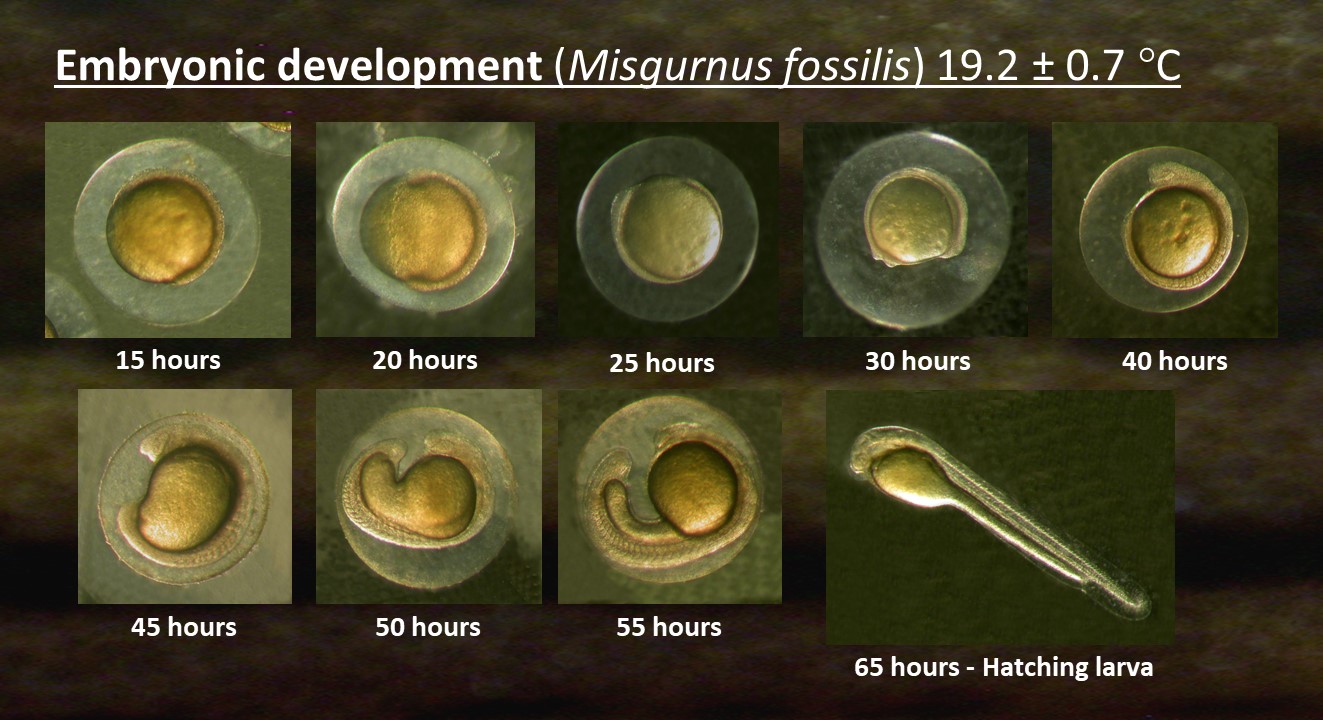
Some of the important steps in the embryonic development of weatherfish (Misgurnus fossilis)
My favourite part of fish ontogenesis is embryonic and larval development, where the most changes can be recognized.
21.05.2023. LinkedIn Post
To START
"Every beginning is difficult." – but also BEAUTIFUL :)

14.05.2023. LinkedIn Post

Did you know?
The world aquaculture production of pond loach (Misgurnus anguillicaudatus) was 357 806 tonnes in 2019, based on the FAO Statistics. China (>99%), the Republic of Korea, and Taiwan are the primary producers.
In comparison, the pond loach was just the 30th on the list of the principal species, and the rainbow trout (Oncorhynchus mykiss) was the 14th with 916 540 tonnes.
I was surprised and happy at the same time to find this specie in the table. Can you imagine the potential of the European native relative species, the weatherfish (Misgurnus fossilis)?
References:
FAO. 2021. FAO Yearbook. Fishery and Aquaculture Statistics 2019/FAO annuaire. Statistiques des pêches et de l'aquaculture 2019/FAO anuario. Estadísticas de pesca y acuicultura 2019. Rome/Roma. https://doi.org/10.4060/cb7874t
FAO. 2023. Fishery and Aquaculture Statistics. Global aquaculture production 1950-2021 (FishStatJ). In: FAO Fisheries and Aquaculture Division [online]. Rome. Updated 2023. www.fao.org/fishery/statistics/software/fishstatj
02.05.2022 Visit to INBO
On the 2nd of May, we visited INBO Research Institute for Nature and Forest (Belgium). We could see how they work with different fish species, especially weatherfish (Misgurnus fossilis). We discussed reproduction protocols to understand and help each other work. Johan Auwerx (Expert) and Jeroen Van Wichelen (Scientific Attaché) spoke about the situation of weatherfish in Belgium. The native populations have many problems because the genetic variations decreased due to isolation, and one invasive species, the northern weatherfish (Misgurnus bipartitus), also endangers the remaining habitats.
(Link to the related article: https://pureportal.inbo.be/en/publications/invasive-weatherfish-misgurnus-bipartitus-may-sound-the-death-kne)
In my opinion, the meeting was productive, and we want to find a way to collaborate more in the future.
03.09.2021. Loaches from the Netherlands

Yesterday (03.09.2021), I was by Steven Klijn in the Netherlands. He gave me three loaches (Misgurnus mizolepis) and a giant aquarium because he would move. They were his favourite fish, so I feel very honoured to take care of them in the future.
Thank You very much, Steven! You are the first PROMOTER of liveloveweatherfish!
